Why is ecosystem stability important for humans?
Remember we are reliant on ecosystems to sustain us. For examples of how other organisms in ecosystems provide services which keep us alive, see
What has nature ever done for me? and dig dirt
Natural change in ecosystems
Ecological succession is the process by which natural communities replace (or “succeed”) one another over time.
Each plant community creates conditions that subsequently allow different plant communities to thrive. For example, early colonizers like grasses might add nutrients to the soil, whereas later ones like shrubs and trees might create cover and shade. Succession stops when a “climax” community forms; such communities remain in relative equilibrium until a disturbance restarts the succession process.
- in primary succession, newly exposed or newly formed land is colonized by living things
- in secondary succession, part of an ecosystem is disturbed and remnants of the previous community remain.

Time frames for natural succession
Primary: hundreds of years
Secondary: 100 to 200 years
Succession is the orderly process of community development that is directional and predictable and results in a stable "climax" state . In other words, succession is not the same as human caused disruption which may occur over and over again e.g. repeated release of sewage into a river system.
Human induced change in ecosystems - disruption
How is the biosphere being altered by human activity?
Humans take more than their share of resources for use and change the systems over very short time spans compared to natural processes.
Ways of measuring biosphere damage
Measurement Method: Earth Overshoot
- Earth Overshoot Day officially marks the point when two factors run out of kilter: humanity’s ecological footprint and our planet’s biocapacity.
- Our ecological footprint is the land we need to produce everything we consume – cropland, fisheries and forests – and the waste we generate.
- Earth’s biocapacity encompasses the resources our planet has available to meet our consumption needs and can regenerate every year.
quote from Earth Overshoot Day. What is it and why do we need it?


Measurement Method: Planetary boundaries framework
According to The nine boundaries humanity must respect to keep the planet habitable
In the mid-2000s, Johan Rockström, founding director of Sweden’s Stockholm Resilience Centre, gathered an international, interdisciplinary team of scientists to unite behind a single goal: define the boundaries for a “safe operating space for humanity” on Earth. They asked themselves: what are the safe operating limits of our planet, and what changes can we force on it before we trigger rapid, catastrophic environmental harm?
In 2009, the Stockholm Resilience Center published the Planetary Boundaries Framework, which outlined nine key human influenced processes that threaten the stability of the entire Earth System. These are:
- climate change due to changes in the composition of the atmosphere
- biodiversity integrity (disappearance of species and their genetic resources)
- ocean acidification
- depletion of the ozone layer
- atmospheric aerosol pollution
- biogeochemical flows of nitrogen and phosphorus
- freshwater change
- land-system change
- release of novel chemicals (including heavy metals, radioactive materials, plastics, and more)
After the 2009 initial release, updates wer published in 2015 and 2023. The most recent release occurred in 2025.
The most recent release includes assessment for all 9 boundaries and shows we have breached 7 of those 9.


Interdependence between the processes considered in this model
The processes delineated in the 9 boundaries framework are not completely separate from each other. For example, land clearing is intimately involved in biodiversity loss, especially if it involves clear-felling or high intensity burning. Ocean acidification can result in the death of species which incorporate calcium carbonate into their structures because acids can dissolve this chemical. Rising temperatures due to climate can cause the death of some species which are unable to alter their heat tolerance mechanisms.
Hence changes in one sector that is still within the safe boundaries, may influence the boundaries of another factor.
A Focus on Biodiversity Loss
An ecosystem is a structure built on the relationships between its elements.
Niche formation increases biodiversity and reduces competition. Mortality rates and birth rates keep the population stable. Consider biodiversity as the equilibrium of naturally fluctuating rates of extinction and speciation
Removing elements i.e.lowering biodiversity makes the whole less stable. The more removed, the closer to complete collapse.
The rate of extinction of species has skyrocketed since the 1500s, as the human population grew and as technology became more powerful and ubiquitous.

Invasive species and their effect on stability
One important way that biodiversity can be lost is through humans transporting species to novel environments in which they have no predators to keep their numbers in check. This has been particularly devastating to island ecosystems. You can read pertinent examples on my site https://misdis.dedide.info
Many of you will be familiar with the game Jenga - building a tower of wooden bricks and then taking them out out 1 by 1 until the tower collapses.
Using this as an analogy of human interference in ecosystems, we can see that removing elements from an interconnected structure makes the structure less stable. It is a less than perfect analogy however.
In real life, rich people take many more turns than poor people to remove resources be it coal, or water, or timber or fish for example.
Using and abusing earth resources
Human extraction and deployment of Earth’s natural materials is already responsible for
- 60% of global heating impacts, including land use change
- 40% of air pollution impact
- more than 90% of global water stress and land-related biodiversity loss


Other damaging events due to human activity
We tend to think of "natural" disaster e.g. floods, droughts, wildfires fires, heat waves as just what the name suggests - not caused by humans. However, there is mounting evidence that the damage done to the earth is influencing the frequency and/or severity of these events. Ecosystems are damaged and destabilsed by these events as they evolved under much more stable conditions.
According to the article, With global warming of just 1.2°C, why has the weather gotten so extreme? published by Yale Climate Connections
Climate change increases extreme weather by adding more heat and moisture to the air and through disruption of fundamental atmospheric circulation patterns.
But all weather is now occurring in an atmosphere fundamentally altered by global warming. Heat is energy. More heat in the atmosphere means that there is more energy to power extreme weather events. Moreover, the extra heat energy from human-caused global warming has fundamentally disrupted atmospheric circulation patterns. The combination of more heat energy and a disrupted atmospheric circulation has made extreme weather events more common and more intense, a phenomenon climate scientist Katharine Hayhoe calls “global weirding.” The resulting weather disasters are severely stressing a society constructed for the old, somewhat calmer climate of the 20th century.
According to a 2024 study, The growing inadequacy of an open-ended Saffir–Simpson hurricane wind scale in a warming world, we now need a new hurricane category to describe the intensity of hurricanes, because the current highest category is inadequate to describe the increased wind speeds.
The current state of the planet
Some statements from a range of scientists on what it all means and what will happen next.
9 Boundaries Framework 2025
The Planetary Health Check is a yearly report on the state of our planet. It presents the most up-to-date assessments of the Planetary Boundaries, gives thorough introductions into cutting-edge science, and spotlights especially relevant aspects of our planet's health. In this 2025 edition, we place a special focus on the Ocean's role in the Earth system, and assess for the first time that Ocean Acidification is the seventh transgressed Planetary Boundary. Seven of nine planetary boundaries now breached – ocean acidification joins the danger zone
 IUCN Red List of Ecosystems Database
The IUCN Red List of Ecosystems Database compiles information from ecosystem risk assessments from around the world that follow the IUCN Red List of Ecosystems Categories and Criteria. The information is gathered and summarized by the IUCN Commission on Ecosystem Management and the Global Ecosystem Management Programme and/or provided to IUCN by the Red List of Ecosystems Partners and other third-parties. You can explore it at https://assessments.iucnrle.org
The 2025 state of the climate report: a planet on the brink
In what has become an annual event, a group of eminent scientists have come together to present their summary of the plant's health.
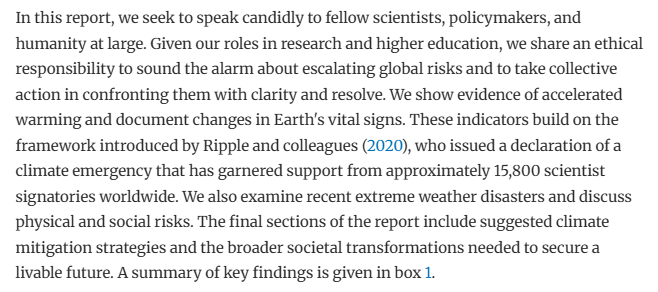
Link BioScience, Volume 75, Issue 12, December 2025, Pages 1016–1027, https://doi.org/10.1093/biosci/biaf149
IPCC Sixth Assessment Report
The Intergovernmental Panel on Climate Change (IPCC) is the United Nations body for assessing the science related to climate change.
A massive report from 2021 and 2022 published as a synthesis report in 2023 can be found at IPCC 6th Assessment Report